Shimonoseki City applied for the fifth round of public applications for the Ministry of the Environment-led “Leading Decarbonization Areas” initiative and was selected in September 2024.
As a joint proposer in this initiative*, we are working to support decarbonization management among local businesses and to build a decarbonization foundation through a “region × finance” approach.
- Group companies participating as joint proposers: Yamaguchi Financial Group, The Yamaguchi Bank, YMFG ZONE Planning, YM Consulting (currently YMFG Growth Partners), and YM Lease.
<Building a Decarbonization Foundation through “Region × Finance”>
Shimonoseki City established the “Shimonoseki SBT Certification Support Subsidy Program” to promote decarbonization among local businesses by encouraging the acquisition of environmental excellence certifications and SME‑tailored SBT certification.In line with this initiative, we have launched the “Shimonoseki Decarbonization Management Support Loan (Sustainability-Linked Loan),” which is designed to be easily accessible for local businesses and encourages them to set and achieve sustainability targets such as CO2 emission reductions.
In addition, Shimonoseki City established the “Subsidy Program for Equipment Introduction in Leading Decarbonization Model Areas” to promote the adoption of renewable energy and energy-efficient equipment among local businesses.
To support this initiative, we have launched a regional leasing program in collaboration with local manufacturers and equipment providers, establishing a one-stop support system for equipment leasing.
By providing these financial products, we will continue to support local businesses’ decarbonization efforts in coordination with Shimonoseki City.
In October 2024, the “Kudamatsu Decarbonization Management Seminar” was held through a partnership between the Kudamatsu Chamber of Commerce and Industry, Kudamatsu City, and the Group to boost momentum for decarbonization within the city.
At the seminar, major companies with operations in the city delivered presentations, sharing their initiatives with local supplier companies.
The seminar reaffirmed the importance of promoting decarbonization management across the region and led Kudamatsu City to establish the “Kudamatsu SME Decarbonization Management Promotion Subsidy Program.”
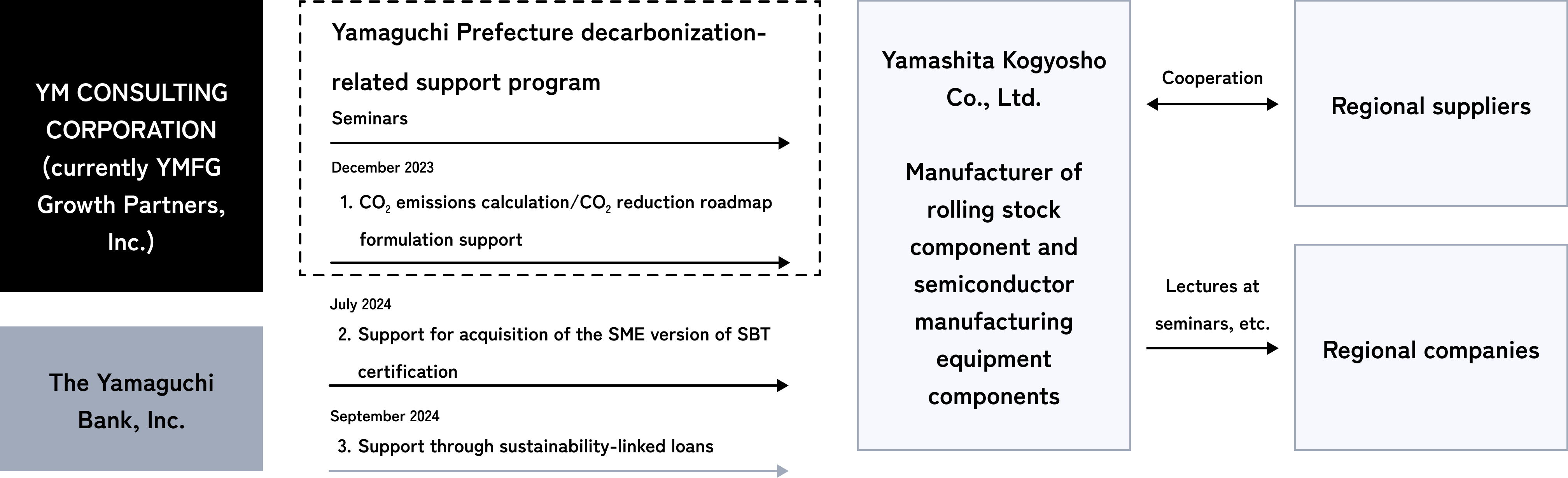
Yamashita Kogyosho Co., Ltd., which received support from YM Consulting (currently YMFG Growth Partners) under a Yamaguchi Prefecture decarbonization support program, began formulating a CO2 reduction roadmap after participating in a seminar under the program, thereby initiating full-scale efforts toward decarbonization.
The company has since obtained SME‑tailored SBT certification—greenhouse gas reduction targets aligned with the Paris Agreement—and is playing a leading role among regional suppliers.
It has also entered into a sustainability-linked loan agreement with The Yamaguchi Bank, setting its SBT-based CO2 reduction targets as SPTs.*
Furthermore, the company actively shares its initiatives by presenting at decarbonization-related seminars for local businesses and contributes significantly to building regional momentum toward decarbonization.
- SPTs (Sustainability Performance Targets): Sustainability-related targets in a company’s strategy that contribute to environmental improvement or the resolution of social issues.
Yamaguchi Prefecture, one of the Group’s primary business areas, plays a key role in the regional economy and employment through its industrial complexes, where basic materials industries such as chemicals, cement, steel, and paper manufacturing are concentrated.
However, these industries also produce high levels of CO2 because their production processes are energy intensive.
Currently, Yamaguchi Prefecture and major companies located in these industrial complexes are advancing efforts toward decarbonization. However, in order to maintain and enhance international competitiveness, there is a growing need for coordinated decarbonization initiatives both within and across industrial complex regions.
In the Group's loan and deposit portfolio, transactions with companies related to industrial complexes account for a certain proportion. Accordingly, how well regional companies respond to decarbonization in industrial complexes and sustain and strengthen their businesses may significantly affect the Group's own business continuity. Decarbonization in industrial complexes will also likely increase demand for large-scale financing. To address these needs, the Group needs to deepen its understanding of industrial structures and external factors related to industrial complexes. This will support business transformation among SMEs.
Based on this recognition, in July 2025, we applied for the Ministry of the Environment’s FY2025 “Project to Promote ESG Regional Finance for the Realization of a Sustainable Society (ESG Regional Issues Resolution Support Program)”*.
Under the support program, we examined how to support regional companies in advancing decarbonization in industrial complexes.
- A program designed to support model initiatives by regional financial institutions that practice ESG regional finance, with the aim of generating environmental and social impact and enhancing regional sustainability.
Basic Approach
The program is built on the idea that regional financial institutions can create value for themselves, their clients, and local communities by identifying ESG-related regional issues and addressing them through practical initiatives.
The program conducts its analyses and related activities on this basis.
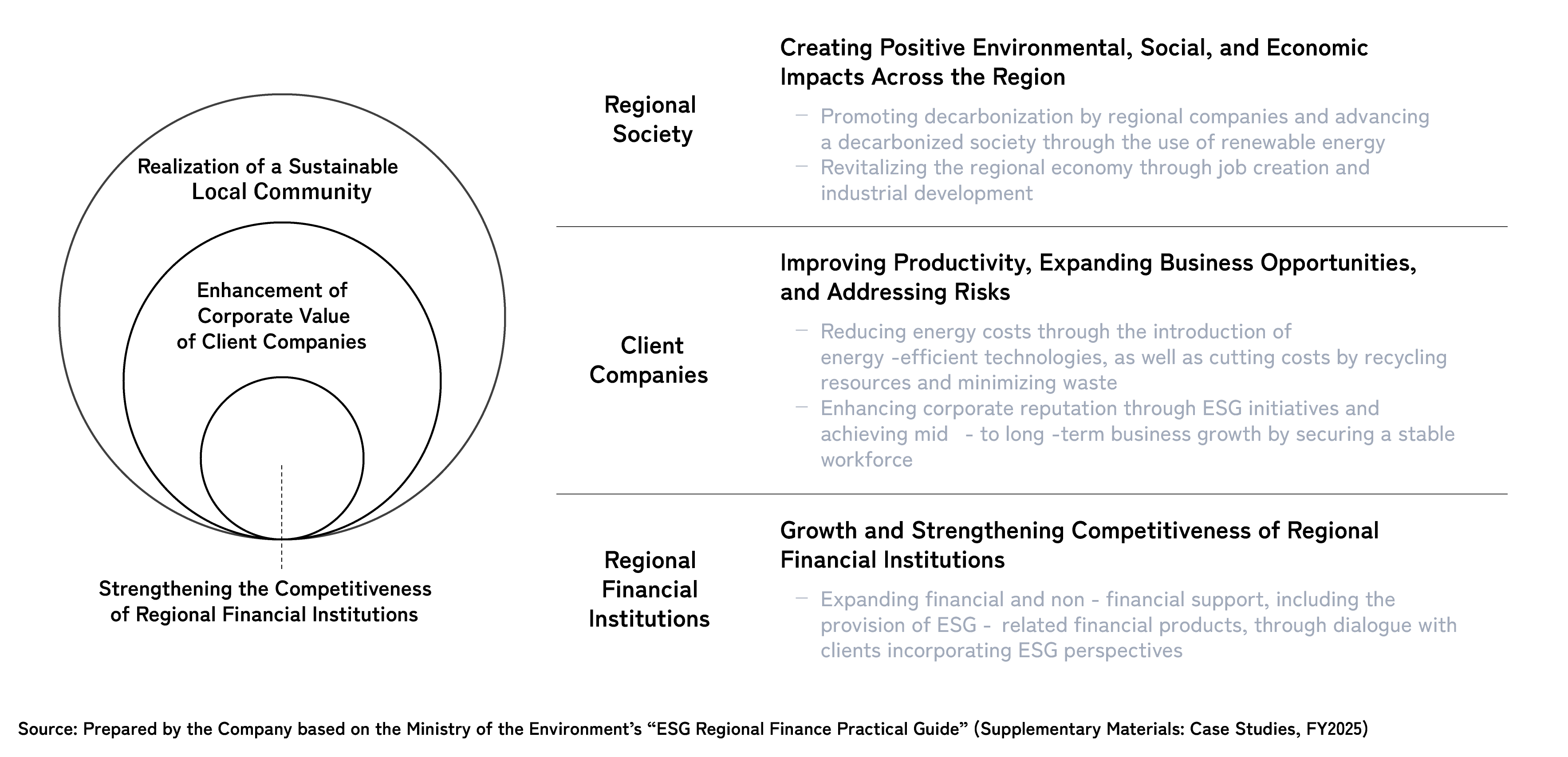
Under the support program, we followed the process outlined below.

Decarbonization in industrial complexes is highly uncertain due to political, economic, and technological factors, so we conducted a scenario analysis under the program and developed multiple scenarios, including progress, stagnation, and contraction of the chemical industry.
We then conducted interviews with a wide range of stakeholders, including Yamaguchi Prefecture, other local municipalities in the prefecture, major companies located in industrial complexes, and their business partners.
Our interviews showed that, at present, decarbonization initiatives undertaken by major companies have not had a significant impact on regional industries, including SMEs.
However, we also found that SMEs and local municipalities have limited opportunities to communicate with major companies and do not have enough information about decarbonization efforts within industrial complexes.
The short-term impact on regional SMEs—our key customers—is expected to be limited. However, we believe it is important to establish systems and environments that enable them to access information at an early stage, adapt to initiatives led by major companies, and undertake business transformation when necessary.
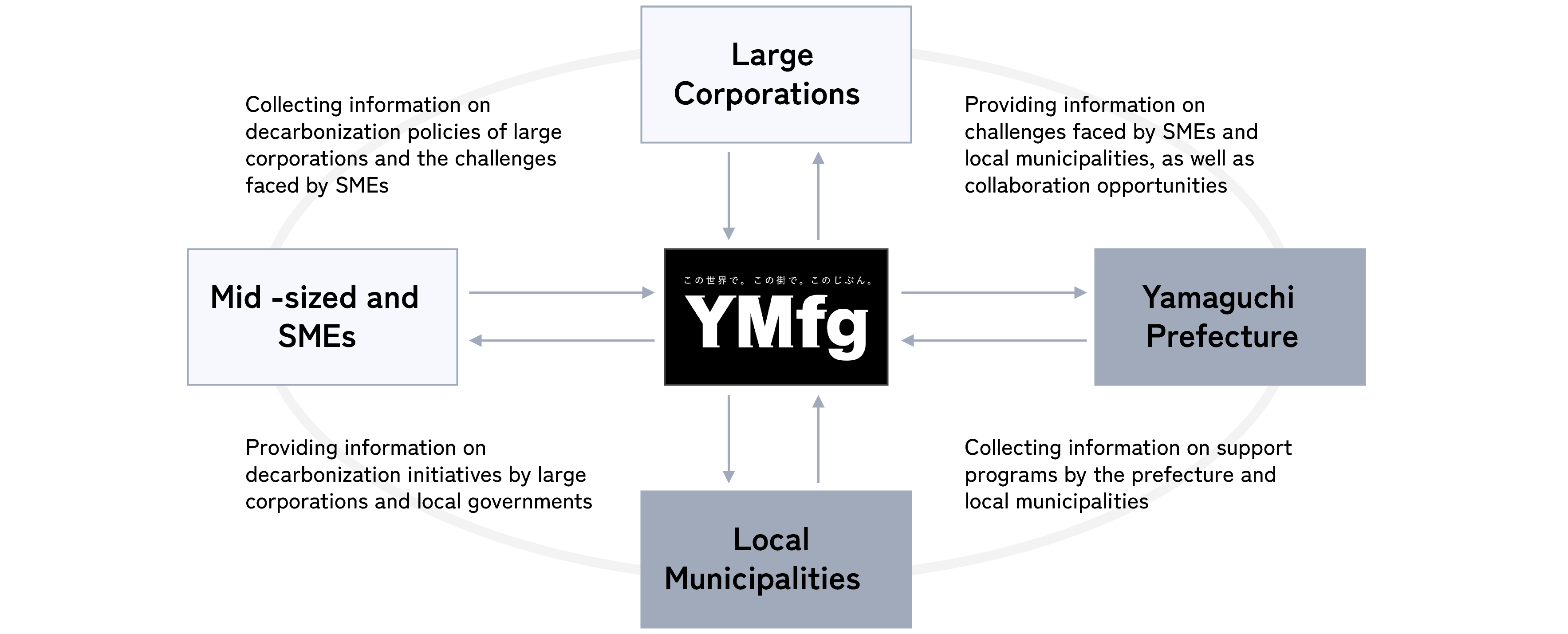
Based on these challenges, we examined potential support measures that the Group can currently provide, including serving as an information hub among stakeholders to reduce information asymmetry within industrial complexes and to promote a just transition.
Conceptual Image of Hub Functions
We have received the following feedback from committee members regarding this support initiative.
Selected Comments from Committee Members (Excerpts)
- The initiative in which regional financial institutions serve as a hub connecting major companies in industrial complexes with local companies is highly valuable. Even small achievements are expected to help identify the next challenges and opportunities.
- The program focuses on the decarbonization transition of industrial complexes, which form the industrial foundation supporting the regional economy and employment. Rather than limiting the discussion to major companies and local governments, it explores a role in expanding discussions to broadly involve regional mid-sized companies and SMEs, representing a strong example of ESG regional finance that proactively addresses regional issues. The “information hub” approach is expected to be effective, and it is hoped that, based on the shared understanding developed here, discussions will advance toward a long-term vision of a “just transition of the regional economy.”
- Through interviews with major companies and other initiatives, this effort demonstrates concretely that regional financial institutions, which can engage in dialogue with a wide range of companies and local governments, can function as a hub within the region. It is expected that the accumulation of such dialogue will contribute to decarbonization and industrial advancement across the region as a whole.
We believe that serving as a hub will improve information sharing among stakeholders. This will help us better understand trends and challenges in industrial complexes and enable us to provide ESG-based assessments and financial support.
For local communities, strengthened collaboration among regional stakeholders is expected to contribute to the future decarbonization of industrial complexes and the development of GX-related industries.
By continuing to engage in dialogue with regional stakeholders, we aim to support the sustainability of industries related to industrial complexes, achieve a just transition, and enhance the Group’s own sustainability.