Based on our management philosophy of “Sound and Proactive Management,” we recognize that establishing an effective corporate governance framework is a critical management priority in order to ensure transparent, fair, timely, and decisive decision-making, and to achieve sustainable growth and the enhancement of medium- to long-term corporate value. Accordingly, we continuously work to strengthen our corporate governance as outlined below.
- We work to ensure the substantive protection of shareholders’ rights, create an environment that enables shareholders to exercise their rights appropriately, and secure the equitable treatment of all shareholders.
- We engage in appropriate collaboration with our key stakeholders, including customers, local communities, shareholders, and employees.
- We appropriately disclose material information concerning management to our key stakeholders.
- We strive to ensure the effectiveness of oversight and audit functions over business execution by the Board of Directors and other established bodies.
- We establish frameworks that promote constructive dialogue with shareholders in order to build long-term relationships.
The Company’s Board of Directors is primarily responsible for deciding important matters related to the management of the Group, including management plans, governance-related matters, and the basic policies for the internal control system, as well as overseeing the execution of duties by Directors and Executive Officers.
In principle, the Board of Directors meets once a month, and the President and CEO serves as the Chair of the Board.
To ensure that the Board effectively fulfills its roles and responsibilities, it is composed of 11 Directors, who collectively possess a well-balanced combination of knowledge, experience, and capabilities. In particular, outside Directors account for a majority of the Board, reflecting our strong emphasis on diversity—taking into account gender, professional background, and age—in order to promote multifaceted and objective discussions. Of the six outside Directors, three are women.
In addition to the Audit and Supervisory Committee stipulated under the Companies Act, the Company has established the Nominating Committee, Remuneration Committee, and Risk Committee as voluntary advisory committees. By receiving reports and recommendations that incorporate objective perspectives from outside Directors and third parties (external experts), the Company aims to enhance the transparency and timeliness of decision-making by the Board of Directors.
Within the business execution framework, the Company has established the Group Management Executive Committee as a decision-making body. Based on the basic policies determined by the Board of Directors, this committee deliberates on and decides important matters relating to the management of the Group. The Group Management Executive Committee is composed of Directors (excluding outside Directors and Audit and Supervisory Committee members), Executive Officers (Division Heads), and Presidents of the Group banks.
In addition, as deliberative bodies for important matters relating to business execution, the Company has established various committees organized by management theme, including the Group Compliance Committee, Group ALM Committee, Group Risk Management Committee, and Sustainability Promotion Committee.
Corporate Governance Structure
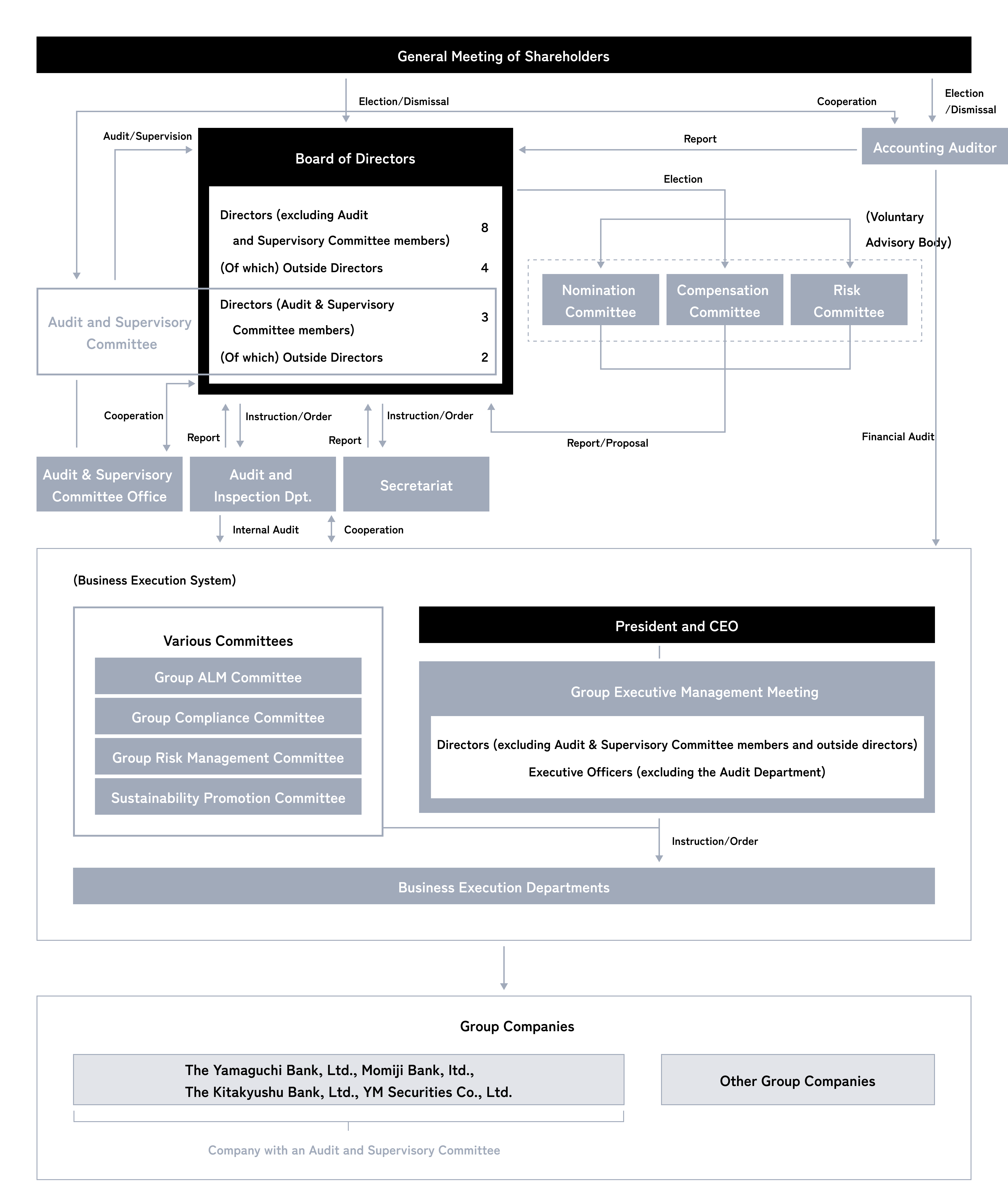
The Group defines an internal audit as a series of processes for objectively and fairly verifying the appropriateness and effectiveness of internal controls, including risk management, and making recommendations for necessary improvements.
Based on this definition, the Company has established “Internal Audit Rules” as the Group’s basic audit policy, and the internal audit departments of the Company and each group company conduct internal audits in accordance with this basic policy.
In addition, the medium-term internal audit plan is based on the management policy and internal and external conditions as a uniform plan for the Group. The internal audit departments of the Company and each group company endeavor to ensure the effectiveness of internal audits
through the conduct of internal audits based on this plan.
The Audit & Inspection Dept., the internal audit department of the Company, leads the planning and drafting of groupwide internal audits, and in addition to conducting internal audits, ascertains and manages the implementation status of internal audits at each group company.
Specifically, it formulates the various rules concerning the internal audits of the Group and the medium-term internal audit plan mentioned earlier, conducts internal audits on the compliance administration departments, the risk management departments, etc., of the Group, and conducts internal audits on the accuracy of financial reports, including the accuracy of the Group’s capital adequacy ratio.
Internal audits of front-line sales sites and outlets are conducted with a focus on verifying the status of functions of compliance and risk management and the effectiveness of the mutual checks.
In addition, it monitors the internal audit department of each group company based on the reporting on the internal audit results and improvement status, etc., received from each group company, gives necessary guidance and advice to each group company, and reports the status of internal audits of the Group to the Board of Directors and the Audit
and Supervisory Committee.
Furthermore, exchanges of information and opinions are conducted by the Presidents, Directors who are Audit and Supervisory Committee Members, and the General Manager of the Audit & Inspection Dept., and it receives instructions and advice on improvement activities of the responsible
departments, as well as management needs related to audit themes, reflecting them on audits.