Respect for human rights is the foundation of all our activities and lies at the core of our corporate social responsibility.
As a financial group working alongside diverse people in local communities, we are committed to promoting initiatives that uphold human rights so that the dignity and rights of everyone we engage with are protected, regardless of the scale or field of business.
Our Human Rights Policy, formulated in June 2023, is aligned with international human rights standards, including the International Bill of Human Rights, the ILO Declaration on Fundamental Principles and Rights at Work, the United Nations Guiding Principles on Business and Human Rights, and the Children’s Rights and Business Principles. This policy applies to all officers and employees of the Group. We also expect all customers involved in our products and services to support this policy, and we require our suppliers and business partners to comply with it.
In light of evolving human rights issues surrounding the Group and the increasing demands on financial institutions, we revised this policy in June 2025.
We will continue to promote awareness and implementation of this policy and strive to further enhance our efforts to respect human rights.
The Group holds regular meetings of the Sustainability Promotion Committee, chaired by the President and CEO, to centrally oversee the deliberation and progress management of sustainability-related matters, including human rights. Matters discussed by the Committee are reported to the Board of Directors, following discussions at the Group Executive Committee as appropriate, and the Board oversees our sustainability initiatives.
The Group has established a Human Rights Working Group under the Sustainability Promotion Committee to build a cross-functional framework for promoting human rights initiatives across the Group. The status of our responses to human rights issues* is reported to the Board of Directors on a semiannual basis, together with progress against the Working Group’s annual plan.
Based on the identification of key human rights issues within the Group conducted in FY2025, the Group has begun establishing rights holder–specific expert teams within the Human Rights Working Group from March 2026 to address these issues.
- Human rights issues: human rights-related themes and topics that companies are expected to identify and address.
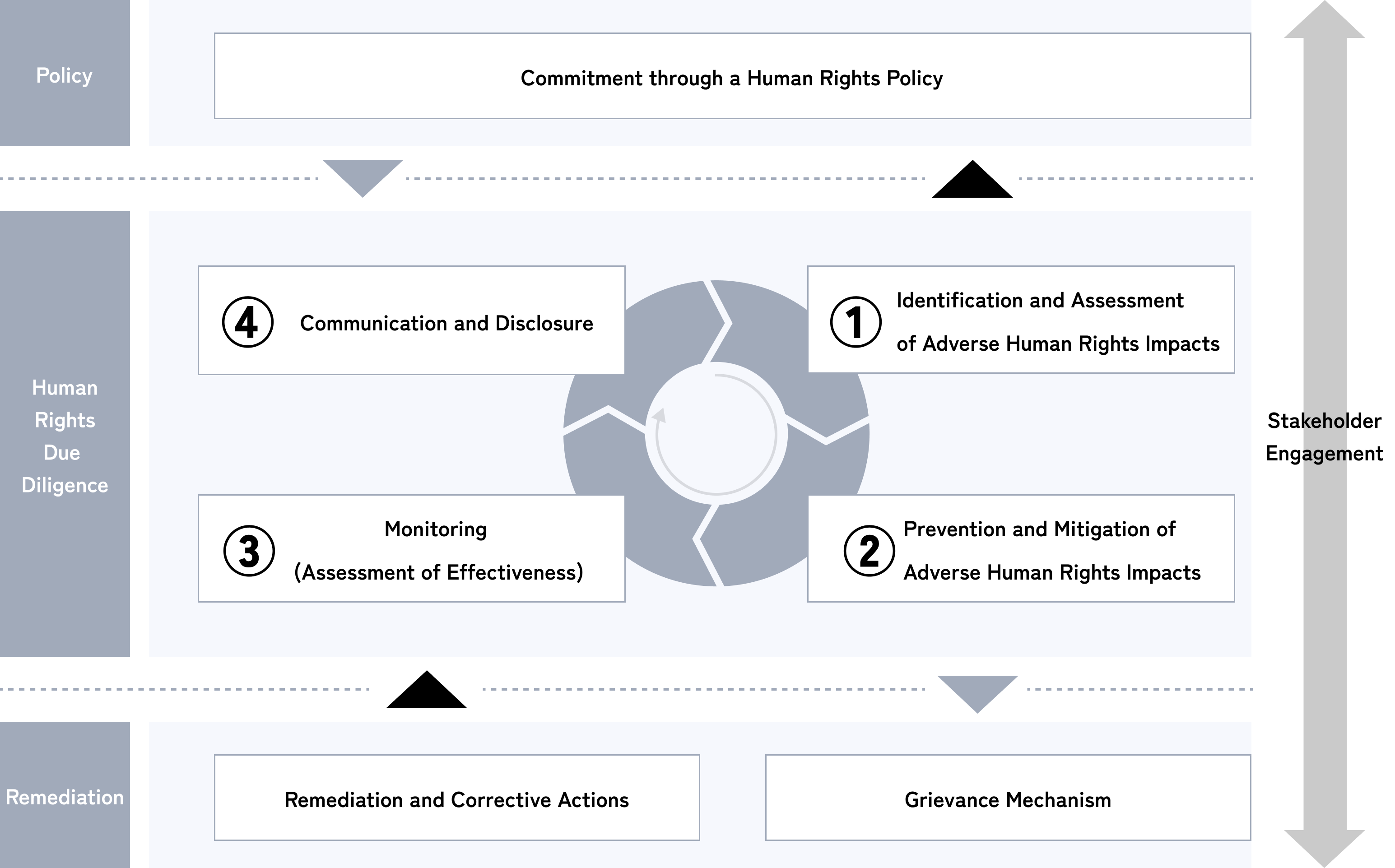
The United Nations Guiding Principles on Business and Human Rights outline three key components as a framework for preventing and mitigating adverse human rights impacts (human rights risks*) caused by corporate activities: a policy commitment, the implementation of human rights due diligence, and access to remedy. Based on this framework, the Group is committed to respecting human rights across its entire value chain, leveraging the expertise of external experts.
- Human rights risks: adverse human rights impacts on rights-holders that may occur or are occurring through a company’s activities and business relationships.
|
Key Initiatives |
||
|
Policy Commitment |
|
|
|
Human Rights Due Diligence |
Identification and Assessment of Adverse Impacts |
|
|
Prevention and Mitigation of Adverse Impacts |
|
|
|
Remedy |
Grievance Mechanisms |
|
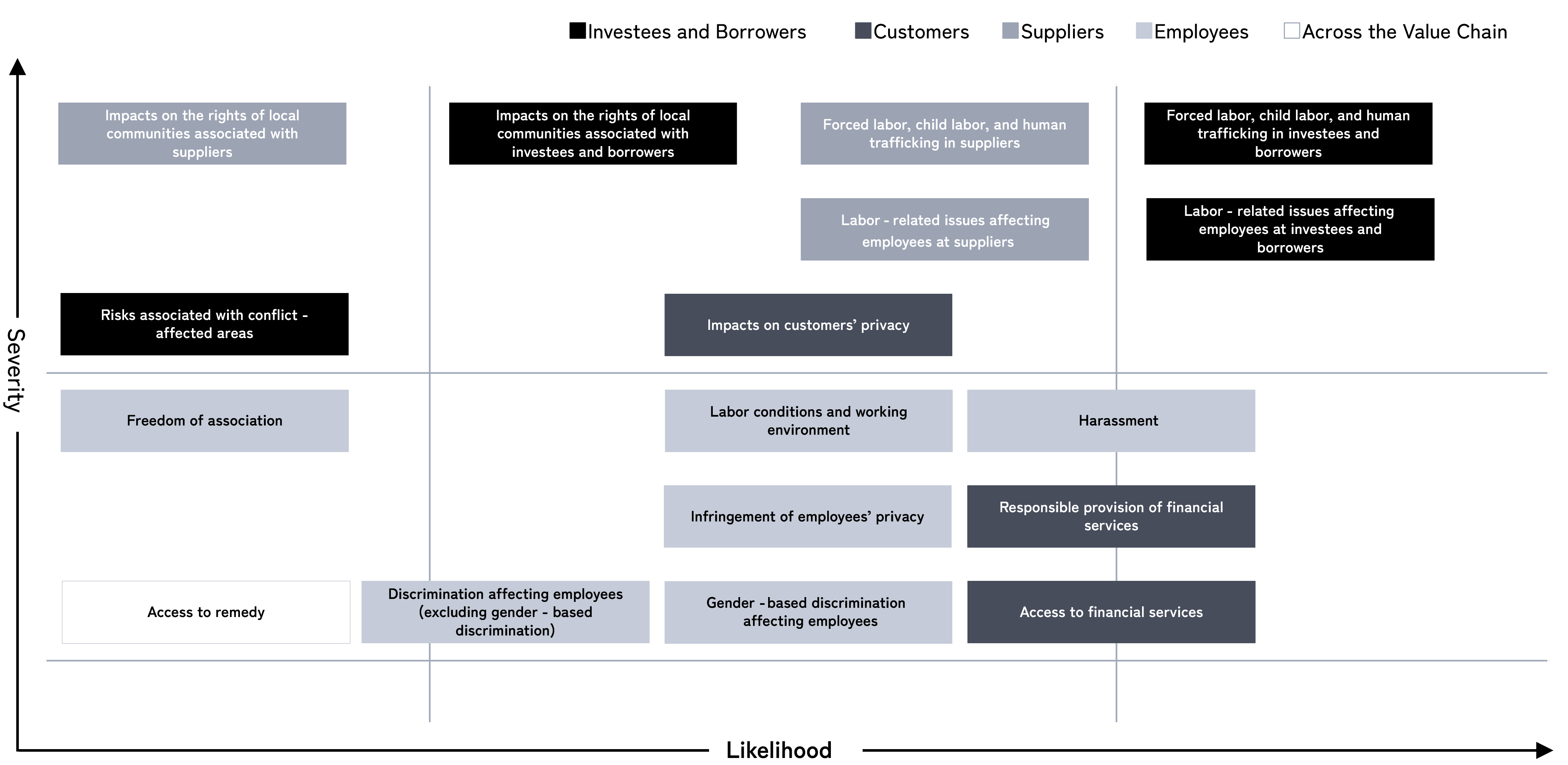
With the support of external experts, the Group conducts internal human rights assessments and evaluates identified human rights risks from both the perspectives of severity*1 and the likelihood of occurrence*2, organizing the results into a human rights risk map. For the key human rights issues identified in the risk map, the Group establishes response policies and priorities and implement initiatives to prevent and mitigate adverse human rights impacts.
- Severity: The extent of harm when the human rights of individuals or groups are infringed (assessed from the perspectives of the difficulty of remedy for victims, the scale of impact on victims, and the scope of impact).
- Likelihood of occurrence: The likelihood that the human rights of individuals or groups may be infringed (assessed taking into account the existence of measures and management systems to address potential human rights abuses).
|
|
|
|
|
|
|
|
|
|
|
Key Human Rights Issues |
Examples of Potential Risk Scenarios |
|
Forced labor, child labor, and human trafficking in our investees and borrowers |
|
|
Labor-related issues affecting employees of our investees and borrowers |
|
|
Impacts on the rights of local communities associated with our investees and borrowers |
|
|
Risks associated with conflict-affected areas |
|
We recognize that our investment and financing activities may have adverse impacts on the human rights of employees of our investees and borrowers, as well as on the environment and society.
In particular, based on the identification of key human rights issues conducted in FY2025, we recognize “forced labor, child labor, and human trafficking in our investees and borrowers” as one of the most critical human rights issues for the Group. In particular, the number of foreign workers in our key regions has reached a record high*, and we recognize that the working conditions of foreign workers may become a human rights issue in the Group’s value chain.
- As of the end of October 2025, the number of foreign workers in our key regions has reached a record high (based on data from the “Status of Employment of Foreign Workers” report published by the Yamaguchi, Hiroshima, and Fukuoka Labor Bureaus).
In FY2026, with the support of external experts, we plan to initiate a human rights impact assessment (identifying, analyzing, and evaluating adverse impacts) targeting foreign workers at a client company of a Group bank (one partner company). In addition, we will continue to review and address other human rights issues through a newly established cross-functional expert team within the Human Rights Working Group.
Furthermore, the Group has established the “Policy on Environmentally and Socially Responsible Investment and Financing” for investment and financing activities that may have adverse impacts on the environment and society, and strives to mitigate and avoid such impacts. Under this policy, businesses that involve human rights abuses, including child labor and forced labor, are defined as categories prohibited from investment and financing across all sectors.
|
Key Human Rights Issues |
Examples of Potential Risk Scenarios |
|
Impacts on customers’ privacy |
|
|
Responsible provision of financial services |
|
|
Access to financial services |
|
We recognize that the provision of financial and non-financial services may have adverse impacts on customers’ privacy, rights, and fair treatment.
Based on our policies and management frameworks, the Group complies with applicable laws and regulations while working to appropriately manage and protect customer information, ensure fair and transparent transactions, and provide products and services tailored to customers’ needs and characteristics. We also strive to maintain customer trust through the proper handling and secure management of information, as well as appropriate controls over information sharing within the Group. For details on our related policies, including the “Personal Information Protection Policy (Privacy Policy),” “Customer Protection Management Policy,” and the “YMFG Policy on Customer-Oriented Business Operations (Fiduciary Duty),” please refer to the “Policies and Guidelines” section below.
Going forward, a newly established cross-functional expert team within the Human Rights Working Group will also advance efforts to prevent and mitigate human rights risks related to our customers.
|
Key Human Rights Issues |
Examples of Potential Risk Scenarios |
|
Forced labor, child labor, and human trafficking in suppliers |
|
|
Labor-related issues affecting employees of suppliers |
|
|
Impacts on the rights of local communities associated with suppliers |
|
We recognize that our procurement and purchasing activities may have adverse impacts on the human rights of suppliers’ employees as well as on the environment and society.
In addition, our “Procurement and Purchasing Policy,” established in September 2025, clearly states that, in our procurement and purchasing activities, we strive to conduct business with suppliers that respect fundamental human rights, give due consideration to occupational health and safety, and do not engage in human rights abuses such as unfair discrimination, forced labor, or child labor. We aim to achieve mutual growth with our suppliers by seeking their understanding and cooperation with this policy and by promoting collaborative initiatives.
We will also continue our efforts to raise awareness among external contractors prior to contract execution by distributing our “Human Rights Policy” and “Guidelines on the Prevention of Bribery.”
|
Key Human Rights Issues |
Examples of Potential Risk Scenarios |
|
Harassment |
|
|
Labor conditions and working environment |
|
|
Infringement of employees’ privacy |
|
|
Gender-based discrimination |
|
|
Other types of discrimination |
|
|
Freedom of association |
|
We recognize that our business activities may have adverse impacts on employees’ human rights, dignity, and the provision of a safe and supportive working environment.
We are committed to preventing harassment, ensuring appropriate working conditions, prohibiting discrimination, and appropriately managing and protecting personal information. Efforts are also underway to develop a workplace where diverse employees can work with peace of mind, while enhancing employee education and training and strengthening consultation frameworks. Going forward, a newly established cross-functional expert team within the Human Rights Working Group will also advance efforts to prevent and mitigate human rights risks related to employees.
|
Key Human Rights Issues |
Examples of Potential Risk Scenarios |
|
Access to remedy |
|
The Group has established a group-wide whistleblowing hotline*. In addition, the Group operates a “Compliance Consultation Desk” to accept a wide range of employee inquiries and consultations related to compliance. Through these channels, the Group has developed a framework and remediation processes for receiving and addressing various reports and consultations, including human rights issues. The Group ensures strict information management of the identities of whistleblowers and persons seeking consultation, as well as the content of their reports and inquiries. The Group has also established systems to protect the privacy of all individuals involved, including not only whistleblowers and consultees but also other related parties.
- Internal and external hotlines have been established, and for the external hotline, individuals can choose to consult either a male or female attorney.